



Embroidered Bag with Nature-Inspired and Cultural Patterns
A crane in flight across the front panel, a lotus opening on the flap — most of the patterns on these bags are copied from older textiles rather than invented for them. Silk thread is laid in tight rows for a petal and left looser for a leaf, over a canvas body that keeps its shape through a crowded day.
Handwork shows. The thread pulls a little differently in each one, the colours sit a shade apart, and a motif that looks ordinary on a screen tends to look better on the bag you actually carry.
- Introduction to Embroidered Bag
- Floral Flair: Nature-Inspired Embroidery
- Free-Spirited Charm: Bohemian Chic Embroidered Bags
- Embroidered Bags Patterns
- Versatile Style: Embroidered Bag for Every Occasion
- Diverse Embroidered Bags
- Artistry Craftsmanship on Embroidered Bag
- Supporting Artisans with Embroidered Bags
- Conclusion
- FAQs
Introduction to Embroidered Bag
An embroidered bag does two jobs at once: it carries what you need, and it carries a design that took hours to work out in thread. Borders of blossom, a single stem, a bird picked out in pale silk — the stitching sits on the surface of the fabric and gives it a texture you can feel as much as see.
The base fabric matters as much as the stitch. embroidered bags are usually built on soft cotton canvas or a linen blend that stays light across a long day, and the embellishments — tassels, glass beads, a second row of stitching along the seam — add movement rather than weight.
Nothing here is seasonal. A stitched embroidered bag hangs beside a denim jacket in spring and next to a wool coat in December, and it works with both, because the pattern carries the colour.
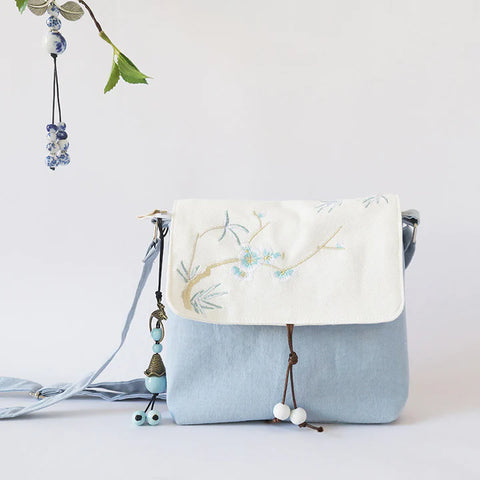
Floral Flair: Nature-Inspired Embroidery
Flowers are the most common subject, and the reason is practical: a flower forgives. A petal can be a dozen stitches or two hundred and still read as a petal; a leaf that sits badly can be covered by the next one; a vine can be lengthened or stopped wherever the panel ends.
There is a slower association too. A full border of blossom or a single stem across a flap carries something of the garden and the attention it takes to keep one, which is why these bags tend to read as calm rather than busy. Blossom, vine and a scatter of leaves also solve a colour problem: worked in silk on a dark ground, they give a plain bag depth without turning it into a print.
Free-Spirited Charm: Bohemian Chic Embroidered Bags
Bohemian embroidery goes the other way. Warm earthy colour instead of pastel, geometric or folk motifs instead of botanical ones, and a heavier hand on the thread so the surface has real relief. Madder red, indigo, ochre and off-white against natural canvas is the usual palette, and the mix of those colours is what gives the style its looseness.
It is easier to wear than it sounds. A fringed crossbody over a long print dress is the festival formula; the same bag with jeans and a plain tee works on an ordinary Saturday; a geometric backpack in that palette reads as the only pattern in an otherwise quiet outfit. Pair it with one strong colour and stop there.
Embroidered Bags Patterns
Floral Elegance Collection
Floral embroidery has meant something specific for a long time; the four patterns below are the ones most often asked for. Each is worked in silk on a dark or natural ground, which is what keeps the flowers from turning sweet, and each carries a different message.
Lotus. Purity, and growth that does not take the mud with it — the flower opens above still water and comes up clean. On a bag the lotus is usually worked in graded pinks with a darker outline: tight satin stitch for the petals so the light catches the crown, a looser centre where the seed pod sits. It is also the pattern that suits plain clothes best, because with a cotton shirt and wide trousers the embroidery is the only pattern in the outfit.
Camellia. Love, said plainly rather than hinted at. Camellias are stitched in deep reds and pinks with rounded, overlapping petals, and the softness of that shape is the point — it takes the edge off a structured bag and keeps it from looking formal. A single bloom across the flap of a small crossbody is enough.
Peony. The king of flowers, kept for prosperity and honour, and the largest pattern in this group. A full bloom with its leaves darkened underneath can fill the whole front panel of a tote, and the stitching is layered so the petals stand up in the light. Deep red is the traditional colour, soft pink the modern one.
Plum blossom. In Chinese painting the plum is resilience: it flowers in the cold, before the leaves come, on branches that look too brittle to hold anything. The design is deliberately uneven — dark angular wood against pale petals — and that contrast is the whole point of it. On a handmade plum-flower crossbody, the branch is stitched right across the front panel, which gives the pattern room to read from a few steps away.
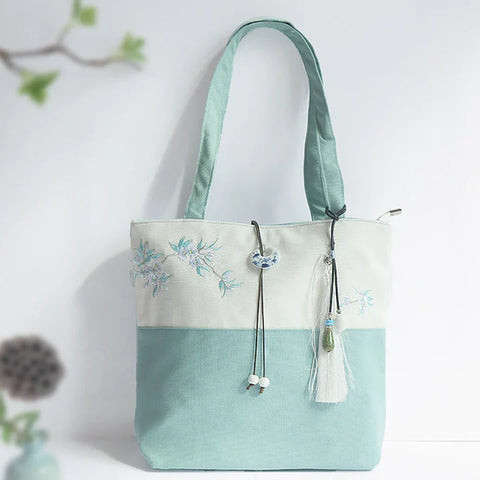
Bohemian Designs
Bohemian patterns are drawn from several traditions at once and rarely stay symmetrical. Three kinds turn up most often on these bags.
Geometric. Triangles, diamonds and zigzags in repeating rows, stitched in contrasting colour. The repetition gives the bag its movement, and the geometry is simple enough that the effect comes from the colour changes rather than the shapes. A single band across the flap is quieter than an all-over pattern; the all-over version is what you wear when the bag is meant to be seen.
Tribal. Earthy tones and bold linear work, with arrows, feathers and animal motifs borrowed from indigenous textile traditions. Heavier thread and a wider stitch give the pattern a weight that suits a large tote, and the colours stay close to the ground fabric — brown, rust, sand, bone.
Floral embellishments. Bohemian flowers are abstract and free-form rather than botanical: bright, contrasting, and deliberately off-balance. An asymmetric spray across one corner does more than a neatly centred motif, and the looseness is the point — these are flowers remembered rather than copied.
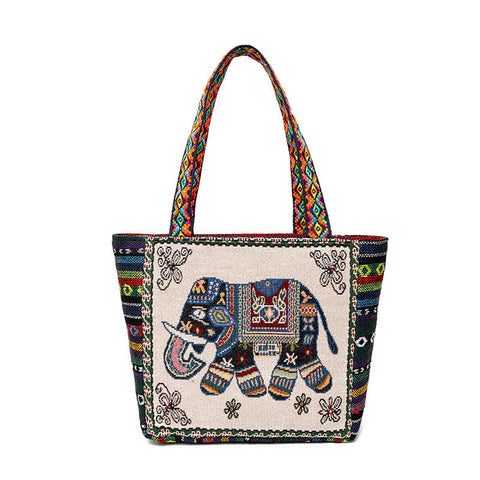
Versatile Style: Embroidered Bag for Every Occasion
The point of a stitched bag is that it moves between situations unchanged. The same canvas body carries a laptop on Tuesday and a change of clothes on Saturday.
One Bag for Workdays and Weekend Trips
- At work: a flat tote on a dark ground with one small motif holds a folder without creasing it and stays quiet beside a laptop bag — the stitching reads as detail rather than decoration.
- On a short trip: the larger tote or a backpack takes two days of clothes, a charger and a paperback. Canvas wipes clean, and nothing on the outside needs protecting.
- As a gift: the pattern carries the message, which is the reason to choose one flower over another — a peony for prosperity, a camellia for affection, plum blossom for someone starting something difficult.
Adaptability in Functionality
- Shape follows use more than style does. A crossbody frees both hands; a tote takes volume; a backpack takes weight.
- The one that works hardest is the bag whose strap shortens, because it moves from a shoulder carry at a desk to a shorter one across the body at night.
- Inside, a lined body and one flat pocket do more for daily carrying than a stack of compartments, which tend to fill up with things nobody looks for.
Elevating Every Look
- Colour does most of the work: a stitched ground with a dark base lifts a plain outfit without adding a second print to it.
- Against a patterned dress or a checked shirt, keep the bag inside one colour family and let the stitching supply the texture.
- If the pattern is strong, keep your clothes plain and let the bag take the colour — the embroidery is the statement, and it does not need help.
Diverse Embroidered Bags
The same handwork turns up in several shapes, and the pattern usually decides which one suits.
Versatile Embroidered Backpacks
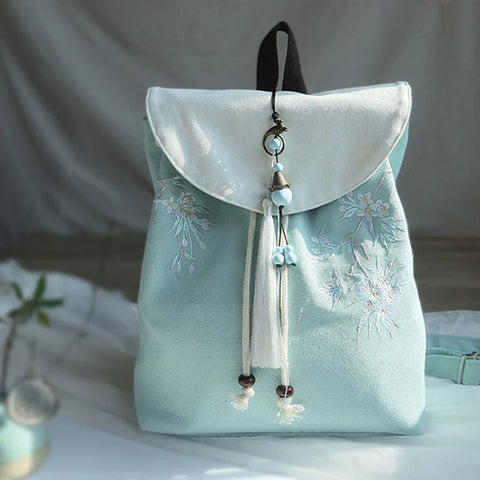
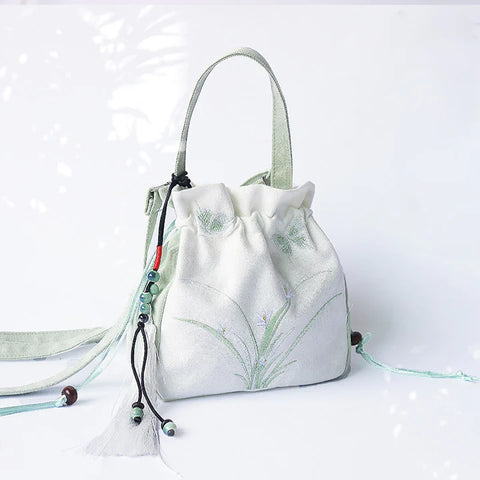
A stitched backpack takes the pattern into something carried every day. A soft pastel ground, a floral spray across the flap, tassels swinging from the seams — the traditional detail sits on a light canvas body, so the bag stays comfortable through a long day.
Embroidered Shoulder Bag & Tote Bag
The shoulder bag and the tote are the quieter versions: a soft, minimal body with the nature-inspired embroidery kept to one area, and tassels or beads for accent. There is room for the daily essentials and a book, and the flat shape sits under an arm without bulk.
Stylish Embroidered Wallets
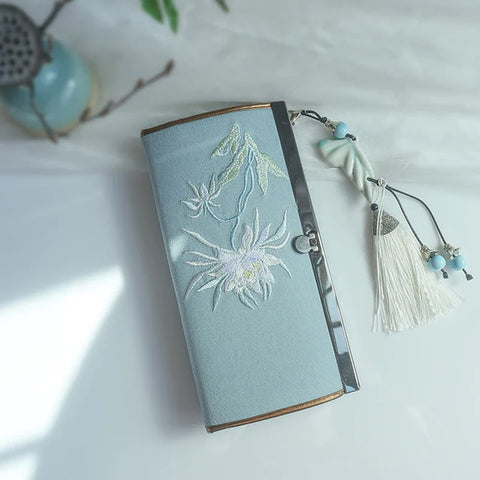
A stitched wallet carries the same floral work in miniature. Soft fabric, a flower worked across the front, a tassel and a few beads — and, despite the size, room for cards, cash, and the small things that otherwise end up loose at the bottom of a bag.
Artistry Craftsmanship on Embroidered Bag
Embroidery is slow by design. A pattern that covers the front panel of a tote can take days, and none of that time can be cut without the result looking thinner.
The work starts with a paper pattern and then moves off it. The artisan chooses tight satin rows for a petal and a looser chain stitch for a stem, and adjusts as the fabric pulls. Thread selection does the rest of the work: silk for shine, cotton for a flatter finish, metallic thread for highlights that catch the light when the bag moves.
Small irregularities are part of the result: a row of stitches that leans slightly, a petal half a shade deeper than the one beside it. They are the marks of a handmade piece.
Traditional Techniques with Modern Flair
- The motifs come from older textile traditions; the bags themselves are modern, with cotton canvas bodies, metal zips and adjustable straps.
- That pairing is deliberate. A pattern that would once have been worked on clothing or a household textile now sits on something that gets used every day.
Celebrating Creativity
- No two pieces repeat exactly, because the stitching is guided by eye rather than by a machine setting.
- The same flower turns up in entirely different colourways from one bag to the next, and that is the reason the patterns above are a beginning rather than a fixed set.
What a stitched bag holds is the hours that went into it: an uneven row here, a colour matched by eye there, a motif chosen instead of a print.
Supporting Artisans with Embroidered Bags
The people who make these bags are part of what they are. Buddha Stones commissions the embroidery from skilled artisans, many of them in communities where the craft is one of the few sources of steady income, rather than buying finished stock from the cheapest workshop.
Patterns are agreed with the makers, thread and ground fabric are chosen for how they wear rather than how cheaply they can be bought, and the money stays closer to the hands that did the stitching.
Conclusion
The patterns do the talking in this guide. A lotus for calm, a camellia for plain affection, a peony for the occasions that deserve one, a plum branch for the difficult stretches — choose by the motif you would still like in three years, not by the one that happens to match a coat.
Then look at the stitching rather than the picture. If you can follow the direction of each row, and the thread sits at a slight angle to the weave, the bag was made rather than printed, and that is the part that lasts.

FAQs
How can I tell whether the embroidery was done by hand?
Look at the back of the panel if you can reach it: hand embroidery leaves thread ends and a slightly uneven reverse, while a printed or machine-worked panel is uniform all the way through. Raking light helps — silk laid by hand stands up from the fabric and casts small shadows along the edge of each petal.
Will the stitching survive daily use?
Silk and cotton thread on canvas is tougher than it looks, but the front panel does not enjoy sharing a bag with keys, coins or velcro. Spot-clean with cool water and a soft cloth rather than soaking it. Dry the bag flat and away from direct heat.
Do embroidered bags add much weight?
Very little. The stitching is thread rather than metal, and a lined canvas crossbody is usually lighter than a leather bag of the same size, because the fabric does the carrying.
What happens to the stitching in the rain?
Cotton canvas sheds a shower and dries without marking; silk thread can dull on the surface if it stays wet and is rubbed while damp. If the bag does get soaked, blot it with a cloth, keep it out of a hot car, and let it dry in the open air.

