



Evil Energy Protection: Jewelry to Wear on Halloween
The lantern on the porch was never only decoration. Samhain, the Celtic night that Halloween grew out of, fell at the close of the harvest, when the herds came down from the hills and the year turned over on 1 November. It was also the night the dead were said to walk, and no household could count on every visitor being friendly. People answered it with small, portable things: a carved turnip set in a window to turn a spirit aside, a stone knotted into a cord and worn against the skin. Some of that thinking survived, and it is what people still mean when they talk about evil energy at the end of October.
This guide stays with the practical half of that history: where the night's bad energy is said to come from, which stones are credited with turning harm away, and how to choose a bracelet, a necklace, or a ring.
- Understanding Evil Energy and Its Origin
- How the Habit of Wearing Protection Began
- Gemstones Known to Block Evil Energy
- Protective Bracelets for Shielding Against Evil Energy on Halloween
- Guarding Against Evil Energy with Protective Necklaces on Halloween
- Evil Energy Shields: Choosing Rings for Protection on Halloween
- FAQs
- Conclusion
Understanding Evil Energy and Its Origin
Three sources of trouble come up again and again in the old accounts of the night: the turning of the year, the dead who never settled, and harm that somebody meant.
Ancient Beliefs and Samhain
The festival underneath Halloween was a harvest marker before it was anything else. Cattle were driven down from the summer pastures, the last of the grain was carried in, and the fires were relit from one shared flame. Celts counted the year from that point, which is why 1 November opened the new one rather than closing the old.
What made the date uncanny was the timing. The world of the living and the world of the dead were said to touch at the turn of the year, so the dead could cross back for a night. They were met with the courtesy a visitor gets: a place set at the table, a light left burning, a door not bolted too early. Not every guest came meaning well.
Unsettled Spirits
A second kind of visitor was treated as a genuine hazard: the dead who never settled. The stories usually attach a reason — a body left unburied, a debt unpaid, a life that ended with a wrong on one side or the other — and it is that unfinished business which keeps them walking.
Since you cannot feed them or toast them, their arrival reads nothing like a welcome guest. Cold in one room of a warm house. A door that will not stay shut. A sleeper waking at the same hour three nights running. The old advice was not to answer it: keep the lit rooms lit, keep the door shut, and never follow a voice that knows your name.
Curses and Hexes
The third source was neither the calendar nor the dead but a person. Folk tradition is thick with witches, warlocks, and sorcerers said to work on this night in particular, aiming a spell at a neighbour, a rival, or a house they held a grievance against. Whatever the intention behind it, the aftermath got described the same way every time: luck that soured with no visible cause, animals that would not thrive, an illness arriving out of season.
That is why the older protections are so small and so specific. An amulet was said to work because of the blessing spoken over it, a talisman because of what it was made of — iron, coral, one particular stone. Either way it was worn where it touched skin, and it never stayed in a drawer. The fear on this night is not complicated: people want something between themselves and whatever is looking for an opening, and jewelry is the version of that you can put on along with your coat.
How the Habit of Wearing Protection Began
Protective jewelry is older than any single faith. It turns up wherever a person had to carry a defense with them — a stone at the throat, a symbol cut into metal, a bead handled while a decision is being made. The material and the figure change from one culture to the next; the logic does not.
Ancient Egyptian Amulets
Egyptians treated amulets as equipment rather than ornament. A piece was set with chosen stones and cut with an inscription, and the two together settled what it was for. Many were buried with their owner, since the journey they were meant for is the longest one a person makes. The Eye of Horus was among the most common, carried for protection and health and for a body expected to be whole again.
Norse Viking Talismans
Norse seafarers scratched their defenses into metal, bone, and wood. The Aegishjalmur, the Helm of Awe, and the Vegvisir were drawn or etched rather than hung from a chain, and both answered the same two hard hours: one for the wearer who has to stay steady in a fight, the other for the one who has to find a coastline in bad weather. Personal safety and navigation were a single problem, and the jewelry served both.
Native American Spiritual Totems
Tribes across North America set animal figures and clan marks into their work, each with a power of its own — a direction, a season, a line of kin. Turquoise carried a reputation of its own, worn to turn harm away and to keep a channel to the spirit world open. A piece like that belonged to somebody rather than to a style. It said who you were, and who was looking after you.
Read the three together and the method repeats: choose the material, cut the symbol with intention, keep it on the body. The pieces below are those three moves in modern materials.
Gemstones Known to Block Evil Energy
Ask the older traditions which stones are for defense and the same short list comes back — dark, or dense, or simply heavy in the hand. None of them ask much of the wearer. You put one on, and its reputation does the rest.
- Black Obsidian: people call it the vacuum cleaner of stones, and the material explains the nickname. Volcanic glass cools too fast to form a crystal structure, so it is said to take in whatever is aimed at it and hold that, rather than send it back. It is the one on this list most often strung as beads, worn against the pulse.
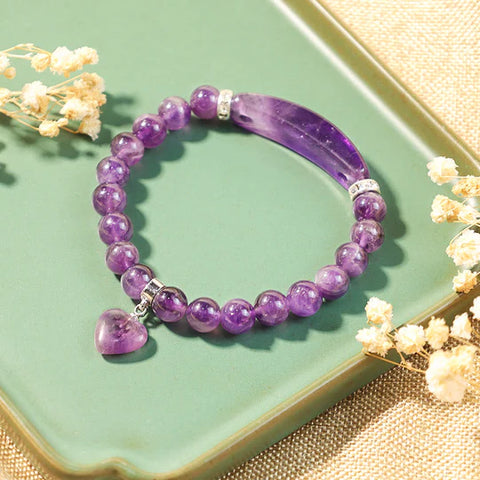
- Amethyst: the violet comes from iron and radiation inside the quartz, and the stone has been read as a guard against being pulled off course since Greek drinkers used it against their own excesses. In the protection tradition it works on mood — it is said to take the edge off a hostile thought before the thought lands. As a ring or a single bead, it is the quietest of the three.
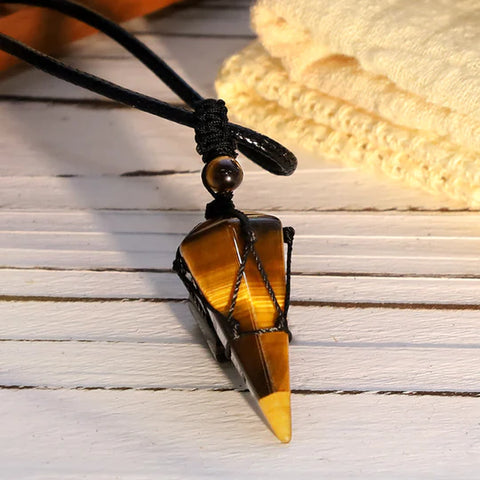
- Tiger Eye: the golden banding gives it away, and this is the stone people reach for when they want to feel unshaken. It is also the one on the list with the shortest line to the oldest fear of all, a stare that carries harm. Tiger eye has been worn against the evil eye for so long that stone and problem are nearly one subject.
What these stones offer is not the shine. Pick one, wear it where it touches skin, and it does the job it has always been given — no ritual required.
Protective Bracelets for Shielding Against Evil Energy on Halloween
The wrist is the place a defense can be checked without looking down, and it sits against the pulse. A bracelet also survives the evening: it stays on through a coat, a costume, and a crowd.
- Chain of Continuity: a bracelet has no loose end. A band that never opens reads as a promise that nothing gets in, which is the oldest argument for wearing one. Links that interlock instead of sitting side by side make that reading stronger, and they fit a wrist better than a flat strap does.
- Charm Bracelets: a charm lets you be specific. The evil eye answers a jealous look, the hamsa hand covers a household, and a mantra — Om Mani Padme Hum is the one most often set in silver — is carried as a line to repeat rather than as a picture to admire. Three charms on one strand are doing three separate jobs, which is the point on a night like this.
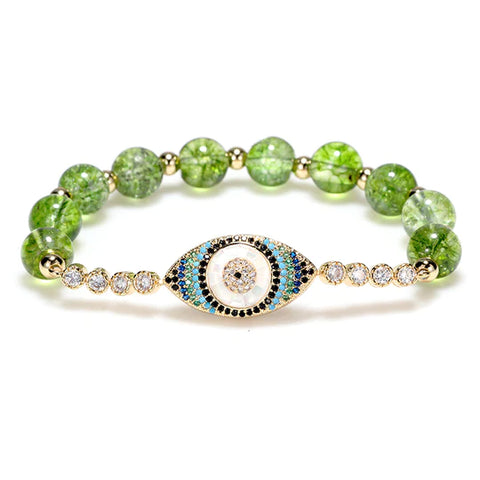
- Incorporating Protective Stones: any of the stones above work here, and a strand can carry two or three of them without losing what each was chosen for. If you would rather not assemble one yourself, this protective bracelet is a peridot and evil eye strand built along those lines.
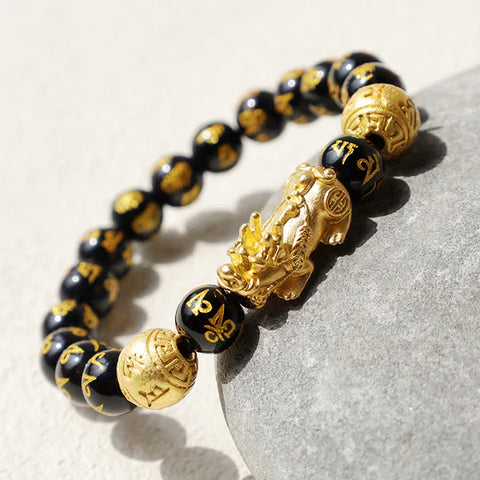
For a piece that already puts two of these ideas together, the Feng Shui Pi Xiu Obsidian Wealth Bracelet is a strand of obsidian beads finished with a Pi Xiu — the stone said to hold on to what it draws in, and the figure traditionally kept for holding on to what is yours. The rest of the protection collection is put together on the same principle.
Guarding Against Evil Energy with Protective Necklaces on Halloween
A necklace puts the piece over the heart, and that is why it keeps coming back in this role — a pendant is the nearest thing to a hand pressed to the chest, and it moves when you breathe.
- Pendants of Power: the shape at the end of the chain decides most of it. The lotus carries a clean start out of mud. The pentagram has been a guard mark far longer than any of its later readings, and the Tree of Life draws the whole idea as branches above and roots below. Pick the one whose story you would actually repeat when somebody asks.
- Sacred Metals: silver and gold are not interchangeable here; the older sources treat them as two halves of one job. Silver is the cleaner, said to draw off what has settled on you, which is why it is the metal for something worn daily. Gold is the keeper: it holds a blessing, a name, or an intention in place, and the pieces meant to be handed down are usually cut in it.
- Layering for Enhanced Protection: lengths, not quantity, are what make this work. A short chain at the collarbone and a longer one falling toward the sternum keep two pendants from tangling, so each sits over a different point instead of doubling up on the same spot. Five chains are a style choice. Two, worn deliberately, are the version the tradition describes.
One piece can carry both halves of that argument: this protective necklace is sterling silver with a moonstone at the center and a pattern set so that it rotates — metal for the clearing, stone for the calmer half of the night, and something for the hands to do while the doorbell keeps ringing.

Evil Energy Shields: Choosing Rings for Protection on Halloween
A ring is the smallest of the three and the only one that stays exactly where you put it. That is its advantage on a busy night: no clasp to check, no chain to catch on a door handle, and a stone that can be turned to face outward.
- The Power of the Right Stone: what sits in the band matters more than the band. Jade has been the purifying choice in Chinese practice for far longer than the ring form has existed, and it is the stone people land on when the piece is meant to be worn for years rather than for one season. Garnet covers the other end of the list — the old sources keep it for the body, worn against physical harm rather than against a state of mind.
- Symbolic Engravings: an engraving turns the band into a sealed object. The evil eye can be cut into the face, a koi fish wrapped around it, or a mantra run along the inside where only the wearer knows it is there. The inside is often the better position: a line you can find with a thumb works whether or not anyone else ever sees it.
- Placement Matters: different fingers carry different readings, and the older lists agree on two of them. The index finger is the one tied to authority and leadership, so a protective ring goes there when the year's difficulty is other people. The ring finger is linked to emotion and partnership, which is where a ring for steadying a mood or a relationship tends to land.
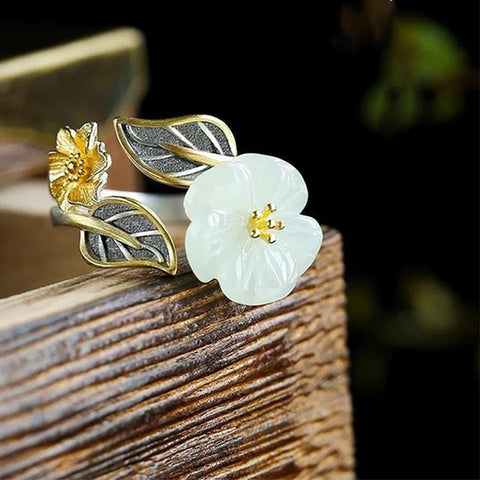
If the risk is your own footing rather than anybody else's intentions, the white jade in this protective ring leans the same way — plum blossom and leaf, cut for luck, on the hand you use to keep things steady.
FAQs
Is it meant to stay on overnight?
Yes — the older practice keeps the piece on while you sleep. Baths, pools, and chains that catch on bedding are the usual reasons to take one off.
Do people keep wearing them after Halloween?
They do: the date supplies the occasion rather than the power, and most people leave theirs on after the decorations come down.
Does it matter if the strand breaks?
Older accounts read a snapped strand as the piece having taken the hit. Have it restrung or replace the stone rather than leaving it in a drawer.
Conclusion
The night asks for three small decisions. Choose the stone that answers what you actually fear — a jealous glance, a mood that will not lift, a year that has come apart — then put it on the part of you that stays covered longest: wrist, throat, or hand. Nothing about it needs an altar, a blessing, or a change of belief. It needs a piece you will still be wearing when the porch light goes out.