



Jasper Stone : Embrace Confidence and Spiritual Renewal
Jasper is quartz in its most patient form: opaque chalcedony, cut and polished for at least as long as people have been carving seals and amulets. Red, brick-brown, mustard yellow, olive green, gray and purple — the color comes from iron and other minerals locked in while the silica set, which is why no two pieces look much alike.
For anyone coming out of a hard stretch and wanting to feel level again, jasper is a decent place to start. Nothing about it asks you to change your routine. You wear it, it catches your eye a few times a day, and that is most of the practice.
- A Stone Carried for Thousands of Years
- What Kind of Stone Jasper Really Is
- The Six Shades Jasper Comes In
- Different Types of Jasper Stones
- Jasper Stone Meaning and Spiritual Renewal
- Jasper Stone: A Tool for Emotional Healing
- The Role of Jasper Stones in Building Confidence
- The Connection Between Jasper Stone and Inner Peace
- Everyday Ways to Keep One With You
- Questions About Jasper Stone
- Conclusion: Embrace the Jasper Stone for Confidence and Renewal
A Stone Carried for Thousands of Years
Jasper has been carried as a protective stone for longer than anyone can date. The name itself traces back through Latin and Greek to a word for a speckled stone, and the material turns up in Egyptian amulets, Roman seals and Bronze Age bead graves. It also happens to be tough enough to wear every day, which is rarer among meaningful stones than the shops tend to admit.
Hold a piece up to the light and nothing shines through it, unlike its cousin agate. That opacity is the point: there is no fire in jasper to distract you. People who keep one around reach for it during the weeks when the to-do list has stopped being funny. After a breakup, after a diagnosis, after a job that quietly wore them down.
Old lists of sacred stones put jasper on the breastplate of the high priest, and medieval lapidaries recommended it to anyone who wanted a clear head. Modern use is quieter than that. A bead in the palm before a difficult phone call, a bracelet that goes on with the watch. The expectation has not changed in two thousand years: that it steadies you enough to act.

What Kind of Stone Jasper Really Is
Jasper Stone belongs to the chalcedony branch of the quartz family. At 6.5–7 on the Mohs scale it shrugs off knocks, which is why it ends up in rings and bracelets rather than in a drawer. The same hardness made it useful long before it was decorative: polished jasper was worked into blades, scrapers and seals because it holds an edge better than most of what was lying around.
Most of the jasper reaching the market today is mined in Brazil, South Africa and the American Southwest, though the stone occurs on every continent and turns up in river gravel as often as in a quarry. Color runs from brick red and mustard to olive, gray, purple and the odd near-black, each shade colored by whichever iron or mineral was present when the silica settled.
Cultures with no contact between them came to much the same conclusion about jasper: it was the stone you kept on your person when you wanted protection. It appears in Egyptian amulets, in Roman signet rings and in the short lists of stones that medieval lapidaries kept for travelers. Few materials have been given so little drama and used so consistently.
What people read into it now is close to what they read into it then: courage that looks ordinary. Getting up, doing the thing, going back the next day. The symbolism is not heroic. It is the symbolism of the daily.
The Six Shades Jasper Comes In
Jasper takes its color from whatever was in the ground around it. Iron oxides account for the reds and yellows, manganese and organic traces for the greens and grays. Six shades do most of the work, both in shops and in practice.
- Red Jasper: The iron-rich one, and the version most people mean when they say jasper. Red jasper gets taken out of the drawer before a deadline, a race, or a conversation that has already been postponed twice.
- Green Jasper: Deep olive to soft sage. Green jasper is the one kept for recovery — convalescence, the tail end of a long argument, the season when you are rebuilding rather than pushing. It is also the shade people give to someone they want to stay on good terms with.
- Yellow Jasper: Mustard and ochre, often faintly banded. Yellow jasper is chosen for concentration: study sessions, paperwork, any stretch of work that is boring rather than hard. It carries the small cheerfulness that makes a long afternoon survivable.
- Brown Jasper: Warm and earthy, close to the color of soil after rain. Brown jasper is for staying put: holding a routine through a difficult season instead of making a change in it.
- Purple Jasper: Usually a soft violet mottled with cream rather than true royal purple. It is the one most often kept for meditation, and the one credited with intuition.
- Gray Jasper: The quietest of the six, gray with darker swirls. Gray jasper is the one to keep on your desk for a week that won't let up.
Which shade you choose matters less than the shops suggest. Most people end up with the color that matches the season they are in.
Different Types of Jasper Stones
Color is only half of it. The pattern is what names a jasper, and three patterns come up again and again in jewelry and on the lapidary tables.
- Picasso Jasper: Named for lines that look like a sketch. It is cut from stone where fractures filled with other minerals, so no two pieces repeat, and it is the jasper people keep near them during a change of direction, when the shape of the next year is still unclear.
- Zebra Jasper: Streaked black and white, sometimes in stripes and sometimes in speckles. It gets chosen by people trying to hold two things at once — a job and a course, a family and a habit they are trying to keep — and who want both to stay standing.
- Picture Jasper: Cut so that the pattern reads as landscape: dunes, mesas, a horizon line. Most of it comes from Oregon and Idaho, where bands of iron and manganese happen to fall that way. It is the variety people use to stay in touch with a place they have moved away from.
The three behave differently in jewelry as well. Picasso jasper hides scratches, zebra jasper shows every chip, and picture jasper needs a cutter who can read the stone and orient the scene before the saw goes in.

Jasper Stone Meaning and Spiritual Renewal
Jasper Stone is not a stone of revelation. What it is credited with has stayed consistent for centuries, and it sits closer to maintenance than to transformation. Four things come up over and over.
- Grounding Energy: Jasper is the stone people reach for when things feel unsteady. Held in the hand, it makes the ground seem nearer: you notice your feet, and then the rest of the day.
- Stability: The stone is credited with steadiness in the practical sense as much as the emotional one. Keeping to a routine after the routine has stopped being interesting, and being the same person on the days when it would be easier not to be.
- Clarity: Not the flashing kind. Jasper is said to clear the noise that builds when too many unfinished things are competing for attention: write the list, pick the first line, stop rehearsing the other nine.
- Absorbing What Weighs on You: The usual account is that jasper holds whatever you hand it, dulling accumulated strain rather than removing it, which is why people who use it tend to do so daily rather than once.
Renewal in this vocabulary is not a breakthrough. It is the slow business of a week going better than the last one. A stone in your pocket will not arrange that for you, but it will remind you that you meant to try, and that is more than most resolutions manage.
Jasper Stone: A Tool for Emotional Healing
Emotional healing gets described as an event. In practice it drains like a wound does: the weight on your chest loosens a little, and then a little more. Jasper is a stone people use during that stretch rather than after it.
- Emotional Blockage Release: The first step is the unglamorous one, saying the true thing out loud to a friend or to a page. Jasper is credited with making that less frightening, and it is the only part of the process that can be hurried.
- Emotional Balance: Jasper gets used in the middle of things. The argument, the anxiety before a flight, the low-grade dread that arrives with the Monday inbox. Not to remove them, but to make room beside them for eating dinner and sleeping.
- Peace of Mind: Boredom is underrated. Twenty minutes with a jasper bead and no phone is a cheap way of persuading the nervous system to stand down, and it works as well on a bus as on a cushion.
One caveat worth stating plainly: no stone substitutes for a doctor, a therapist or a week off. Jasper is a reminder, and reminders only help if something is already trying to happen.
The Role of Jasper Stones in Building Confidence
Confidence is a poor word for what jasper is good for. Composure is closer: doing an ordinary thing in front of other people without your hands shaking. Jasper bracelets are usually strung with wooden beads, and the pairing is not decorative. Wood keeps the weight light enough to forget, which is how a reminder survives a long day.
The claim is not that jasper makes anyone braver. It is that it shortens the distance between knowing what to do and doing it. That distance is where most confidence problems actually live. The email that sits unsent, the question you do not ask in the meeting, the call you keep moving to tomorrow.
Wood and jasper seem to work better together than either does alone, though the honest explanation is probably the one that applies to a wedding ring or a wristwatch: an object you touch without thinking becomes a cue. Wear the bracelet on the days you already know will be hard, and treat the clasp as the reminder. Wear it on the easy days too, so that it stops being a signal and starts being yours.
The Connection Between Jasper Stone and Inner Peace
Inner peace is the phrase that sells the most jasper and explains the least. Put concretely, jasper is quiet: matte, opaque, holding no light and sending none back. People who keep one around describe the effect in domestic terms. Fewer 3 a.m. inventories of everything that could go wrong.
- Promotes Emotional Stability: Jasper is used to flatten the swing in both directions — the 2 a.m. certainty that everything is ruined and the next morning's conviction that it is all fine. Flat is not dull; flat is what lets you plan.
- Brings Calmness: The aim is not to feel nothing. Jasper is generally described as taking the panic out of a feeling while leaving the feeling intact, which is a more useful trade than it sounds.
- The Lotus: Lotus symbols appear on jasper bracelets for the same reason they appear on temple walls. The flower opens in muddy water and does not complain about it, so carving one into jasper is a way of saying that growth happens in the conditions you actually have.
A bracelet or necklace with the lotus mark carries that idea around with it, which is why Jasper Stone carved with the lotus is the version that turns up most often. The mark is small and easy to miss, which is roughly how peace arrives anyway: without announcement, while you are doing something else.
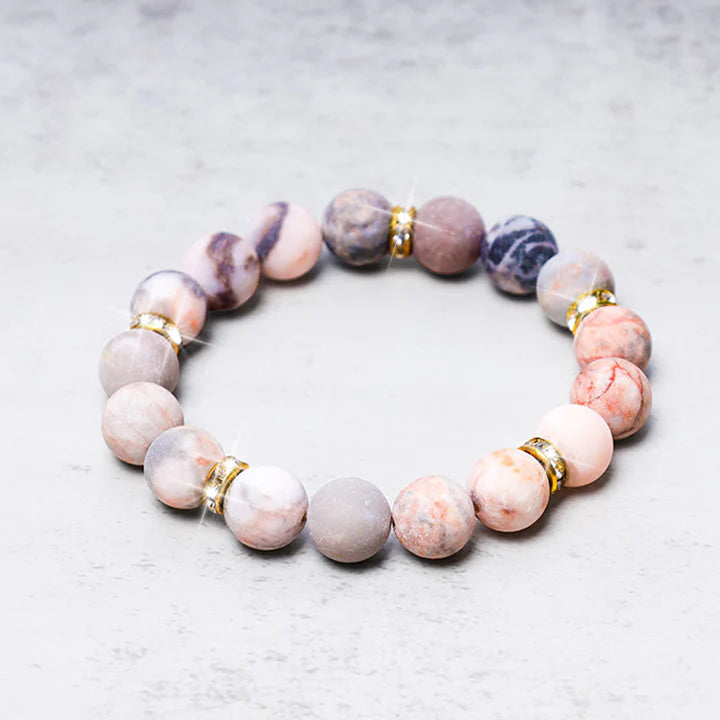
Everyday Ways to Keep One With You
None of this needs a ritual. Keep a jasper in your pocket, or wear the bracelet and let the weight of it remind you to slow down. Four ways people actually use it:
- Wear It: A bracelet or necklace puts the stone somewhere your eye lands a dozen times a day. At the sink, at the keyboard, reaching for the phone. That is the whole mechanism: the reminder arrives before the habit does.
- Keep One Where You Sit: A jasper on the desk or the nightstand does the same job at a distance. It does not have to be a display piece. A tumbled stone the size of a thumbnail is enough, and it survives being knocked onto the floor.
- Hold It While You Meditate: Hold it in your left hand if you tend to drift. The weight does more for focus than the intention does, and ten minutes is plenty to start with.
- Count on a Mala: A 108-bead mala gives your hands something to do, which is often all a restless mind needs. A Tibetan Green Jasper Protection Mala Bracelet is strung with green jasper, black onyx and tiger eye, so the stone in your hand and the stone doing the grounding are the same one.
None of this requires belief. It requires a stone kept somewhere you will keep seeing it, and roughly two weeks for the sighting to stop being novel.
Questions About Jasper Stone
How Do I Tell Jasper and Agate Apart?
No, though they are close relatives. Both are chalcedony, which is to say microcrystalline quartz, and the two often form in the same deposit. The difference is what you can see through. Agate is translucent and layered, jasper is opaque with its color running through the whole stone. A piece with a banded rim and a solid middle sits honestly on the line between them.
Is red jasper dyed?
Sometimes. Natural red jasper gets its color from iron oxide and holds up well on its own, but dyeing is widespread in the trade, especially for blues, purples and anything unnaturally vivid. On a dyed stone the color pools in cracks and pores and follows the fractures. Natural color follows the pattern the stone already had.
Can jasper get wet?
The stone does not mind, since quartz does not dissolve. The string is the problem. Most beaded bracelets are strung on elastic or silk, and neither enjoys chlorine, salt water or a long soak. A shower will not ruin it; a week of swimming probably will, and hot springs are the worst of the lot.
Is jasper a birthstone?
Not in the modern list. Bloodstone, a dark green jasper flecked with red, is the traditional birthstone for March, which makes jasper the quiet answer for anyone born in early spring who never warmed to aquamarine.
Conclusion: Embrace the Jasper Stone for Confidence and Renewal
Pick the color you are drawn to — red for drive, green for recovery, brown for steadiness — and let it be the one small thing in the day that does not change. Confidence and renewal are not handed over by a stone. They are rehearsed, and jasper is a rehearsal you can carry.


