



Pendant Necklace Overview: Materials, Meanings, and Gift Ideas
- What Is a Pendant Necklace?
- Materials and Meanings: Jade, Pearl, Gold, Silver, and Crystal
- Symbol Pendants: What the Motifs Mean
- Men’s Pendant Necklace
- Women’s Pendant Necklace
- A Gift of Enduring Beauty: Pendant Necklaces as Presents
- Ideal Chain Length for a Pendant Necklace
- How to Style a Pendant Necklace
- Layering Pendant Necklaces
- Care and Storage
- FAQs
- Conclusion
A pendant necklace is a chain with one job: to hold the object people actually look at. The links, the clasp, and the small jump rings exist only to keep that object at the right height, which is why a pendant tends to be chosen rather than simply bought.
The same material rarely behaves the same way twice. A slice of jade cut into a flat round buckle throws back light in a single bright band; the same stone carved into a Pixiu breaks that light into shadow, and the pendant reads as older and more deliberate. Profile matters more than size: a ten-millimetre stone with depth holds a room better than a heavier one lying flat.
The sections below cover the five materials that come up most often and what each is said to mean, the symbol pendants worth knowing, how men’s and women’s styles differ, how to match a pendant to a neckline and a chain length, how to layer without a tangle, and how to keep the piece looking new. Gifting comes near the end.
What Is a Pendant Necklace?
A pendant necklace is a chain with a pendant suspended from it, and the pendant is the focal point; the chain only decides where that point falls. Whether the piece carries a gemstone, a small charm, or a symbol cut in metal, it says something a plain chain cannot.
The range runs from a hair-fine chain with one small stone to a pendant broad enough to cover a palm, which is why the same piece suits a Tuesday as easily as a wedding.
Materials and Meanings: Jade, Pearl, Gold, Silver, and Crystal
Five materials cover most pendant necklaces, and each arrives with a reputation attached — usually the reason the piece was bought.
Jade Pendant Necklace
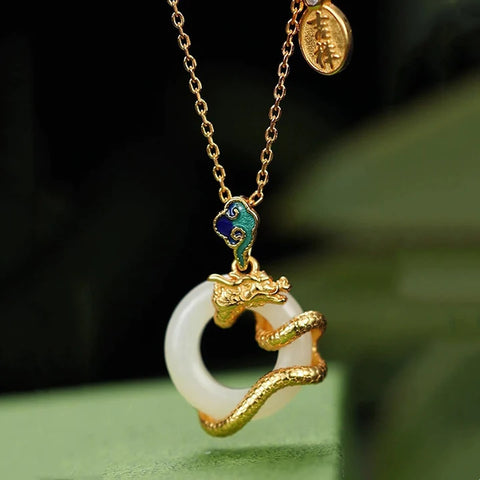
Rooted in centuries of tradition, jade is admired for its green tones and its symbolic tie to nature. Many believe a jade pendant offers harmony and protection, calming the mind and shielding the wearer from negative energy. It is also easy to live with: a jade pendant necklace sits as well over a linen shirt as under a collar.
Pearl Pendant Necklace
Pearls have long stood for wisdom and purity, and each one arrives with a story built in: it forms slowly, inside a shell, with no help from a cutting wheel. A pearl pendant necklace carries those older ideas of clarity, and the soft glow flatters a formal dress without tipping into glitter.

Gold Pendant Necklace
Gold has meant wealth and warmth for centuries, and it still carries both. It warms a complexion in a way silver cannot, which is why it works against skin in winter and against dark fabric the year round. It is also the piece people buy to mark something: a promotion, a milestone birthday.
Silver Pendant Necklace
Silver is the cooler, brighter option, associated with clarity, focus, and the cleansing of energy. A silver pendant necklace reflects the light around it, so it sharpens a plain outfit rather than softening it, and it is the material most likely to survive daily wear. Sterling silver tarnishes, but it cleans up with a cloth in seconds.
Healing Crystal Pendant Necklace
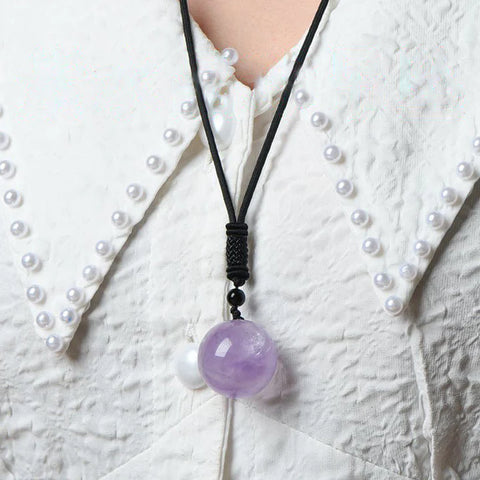
Crystals are chosen for a property rather than a look — amethyst for calm, rose quartz for love, and a long tail of stones in between. A crystal pendant necklace works like any talisman: a small reminder of what the wearer means to keep in mind.
Symbol Pendants: What the Motifs Mean
A pendant also offers a small surface to carve — a syllable, a shape, a figure. These four motifs carry real weight, and none of them is decorative in origin.
Om Mani Padme Hum
The mantra comes from Tibetan Buddhism, and on a pendant it usually appears as six syllables engraved around a cylinder or stamped across a disc. It is tied to awakening and compassion, and it is worn as a safeguard: peace and protection for the wearer, and a purification of mind.
Dorje Vajra
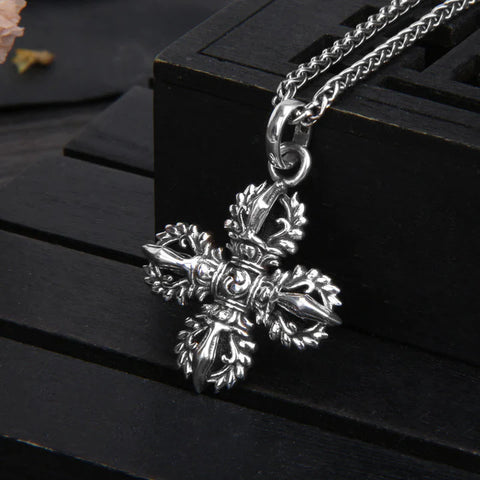
The Dorje, or Vajra, stands for indestructibility and irresistible force — the settled quality of a mind that will not be moved. It is worn for protection, in the sense of clearing obstacles rather than fighting them, and the double form with prongs at either end is the shape most often cut in silver.
Yin Yang
Yin Yang comes out of Taoist philosophy, and its point is easy to misread: the two halves are not rivals but phases of one cycle, each carrying a seed of the other. The pendant is bought for balance, which is why it turns up on people whose lives sit firmly on one side of that equation.
Buddha
A Buddha pendant stands for wisdom, enlightenment, and the end of suffering, worn less as a lucky charm than as a nudge toward patience and attention. Designs run from a plain seated silhouette to detailed figures with inscriptions on the reverse.
Men’s Pendant Necklace
Men’s pendant necklaces moved from the margins into ordinary rotation because they do two jobs at once: they carry a symbol, and they give a plain shirt or jacket a fixed point. These three are the ones people ask for most.
Cross Pendant Necklace
The cross is a well-loved choice for men, symbolizing faith, hope, and protection. Its clean geometric lines suit casual and formal wear alike, and silver or stainless steel holds up to daily use.
Wolf Tooth Pendant Necklace
The wolf tooth represents strength, courage, and independence; in many cultures the wolf stands for protection and raw energy. These pendants are made in metal or carved from bone, and the rough silhouette is the whole appeal.
Pixiu Pendant Necklace
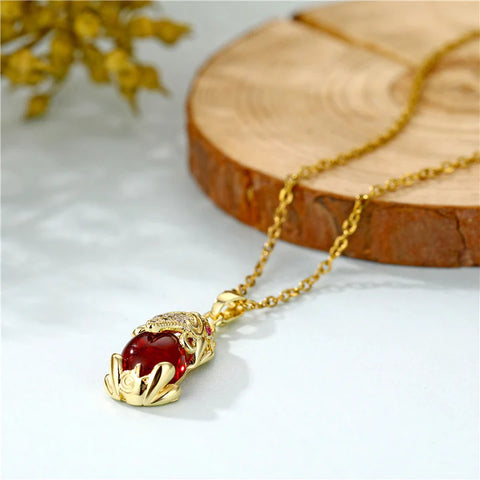
Pixiu comes from Chinese mythology, where the creature draws wealth in and keeps it there. Wearing one is believed to attract good fortune and guard against negative energy, and it is usually worked in gold or jade.
Women’s Pendant Necklace
This is where a pendant stops being an accessory and becomes a signature. Three shapes account for most of it — a heart, a peace buckle, and a Buddha figure, the last of which is covered above; the first two have very different reasons for lasting.
Heart Pendant Necklace
A heart is the plainest symbol on the list and the one that ages best: love and affection, nothing more complicated. It is given as a token and worn as a statement, in gold, in silver, or set with stones.
Peace Buckle Pendant Necklace
The peace buckle comes out of Chinese culture and stands for harmony, peace, and protection. Usually cut from jade, its rounded ring suggests continuity rather than a beginning or an end, and it suits anyone who wants a cultural root rather than a trend.
A Gift of Enduring Beauty: Pendant Necklaces as Presents
Gifting a pendant means handing over a small object with a meaning already attached, which is why it works when a card does not. The pieces discussed here sit together in one necklaces and pendants collection, and two routes make the choice easier: the recipient’s birthstone, or their zodiac sign.
Birthstone Pendants
Every month is tied to a stone, and a pendant set with the recipient’s own month says quietly that the date mattered. January’s garnet is read as protection; September’s sapphire stands for wisdom and purity. Unlike a trend piece, the meaning does not expire.
Zodiac Pendants
For anyone who follows their sign, a Leo pendant speaks to strength and courage, and a Pisces piece is read as intuition and artistic instinct. It suits someone who already knows their sign by heart.

Ideal Chain Length for a Pendant Necklace
Chain length changes how a pendant reads more than the pendant itself does: it decides where the piece lands, and therefore which necklines it can be worn with. For most people, 18 inches puts the pendant at the collarbone and works with the widest range of outfits.
Longer chains change the mood. A 20 to 24-inch chain lets the pendant sit lower, stretching the line of the neck and making layering easier; it also solves a high neckline, where a short chain disappears. A 16-inch chain brings the pendant close to the throat, which suits delicate designs and open collars.
How to Style a Pendant Necklace
Once the piece is chosen, two decisions do most of the work: how formal the outfit is, and where the neckline sits.
Everyday and Casual Wear
For a relaxed day, a small, uncomplicated pendant does the most good. A thin chain with one small stone sits well over a t-shirt, a knit, or a sundress without asking for attention.
Office and Professional Settings
At work, aim for a pendant that reads as considered rather than as a topic of conversation. A pearl, a slim bar, or a small geometric shape on a fine chain works with a shirt or a blazer.
Formal Events and Evenings
Formal wear is where a pendant is allowed to carry the whole look. A single bold piece against a plain cocktail dress needs no other jewellery — stop at one, because a statement pendant competes badly with a statement earring.
Matching the Pendant to the Neckline
The neckline decides more about the right pendant than anything else, and the logic is simple: mirror the shape of the fabric rather than fight it. A V-neck or a wrap dress wants a drop or another slim vertical shape, because that line lengthens the neck instead of cutting across it.
Broad and high necklines work the other way. A boat neck, a crew neck, or a turtleneck leaves a wide flat area to fill, and a short pendant in the middle of it looks stranded; longer chains, or two or three strands together, spread the interest. Over a high collar, the pendant reads better above the fabric.
Layering, recycled materials, and one-off engraving are the currents running through pendant design at the moment: none of them is new, and none will date quickly.
Layering Pendant Necklaces
Layering turns a pendant necklace into an outfit of its own, and it fails for mechanical reasons rather than visual ones: chains tangle, pendants collide, and the result looks accidental. Four things decide whether it works.
Start with a Base Chain
Begin with the shortest, simplest piece, something that sits just below the hollow of the throat and can be worn alone on days when the rest comes off.
Use Length to Build Depth
Give each layer two or three inches of clear air. When the gaps are real, every piece stays visible and the chains have room to move; when they are tight, everything tangles within the hour.
Mix Textures and Weights
Contrast keeps a layered set from reading as one heavy necklace. A fine cable chain beside a heavier curb chain, a matte finish beside a polished one — the difference is what makes the arrangement look intentional.
Balance the Pendant Sizes
Only one pendant should be the centre of attention. Put the largest piece on the longest chain, where the eye finishes, and keep the shorter layers small.
Care and Storage
A pendant sits against skin all day, so it collects oil, perfume, and sunblock, and it is usually taken off in a hurry.
- Clean by material: a soft dry cloth for everyday marks; lukewarm water with a drop of mild soap for gold, silver, and most crystal; a barely damp cloth for pearls, which dislike soaking.
- Store it alone: a hook or a divided box stops chains kinking, and a hard stone should not share a drawer with pearls or unpolished metal.
- Check the small parts: the bail, the jump rings, and the clasp take all the movement, and a jeweller can tighten or replace them before a pendant is lost.
One habit is worth adding: put the pendant on last, after perfume and hairspray, and take it off first. For pearls and plated chains that matters more than any cleaner.
FAQs
Does a pendant necklace make your neck look shorter?
The pendant’s own proportions matter more than where it hangs. A wide, flat disc fills the space beside the neck and flattens it, while a narrow vertical piece — a slim bar, a teardrop, a thin jade cylinder — draws the eye downward instead of across. Check the height of the pendant, not the position of the chain.
Can you wear a pendant necklace with sensitive skin?
It depends almost entirely on the metal touching the skin. Sterling silver is the common low-reaction choice, and surgical steel and titanium are usually tolerated best of all; costume pieces with an unnamed base metal are the usual culprit, especially under the clasp, where sweat collects. Change the chain first — a metal pendant on a cotton cord often settles the problem.
Should the pendant and the chain be the same material?
Not necessarily, but the pairing should look intentional. Silver chain with jade or crystal is a long-established combination, and gold chain with a pearl or a golden Pixiu is the other common contrast. Keep the hardware consistent: if the bail is gold, an all-silver chain reads as a mistake rather than a choice.
How can you tell whether a jade or pearl pendant is real?
Weight and surface are the two best signals. Real jade feels heavier than it looks and cool against the skin, and it shows fine internal structure rather than a uniform, glassy finish. A real pearl has a lustre that shifts as the light moves and a weight a plastic bead cannot imitate.
How do you choose a pendant necklace for a man or for an older relative?
For a man, the chain matters most: a heavier box or curb chain, 2mm and up, carries a pendant without looking fragile. For an older relative, check the clasp — a large lobster clasp is far easier to work than a small spring ring — and keep the piece light, since a light pendant gets worn far more often.
Why does a pendant keep flipping to the back of the chain?
This is a balance problem, not a fault. A pendant lighter than its bail, or hung on a chain much thinner than the channel it passes through, will rotate as the wearer moves. A heavier or wider bail, a pendant broader than the chain path, or a station design with two points of attachment will hold it still.
Conclusion
A pendant is the closest thing in a jewellery box to an ordinary object: small, worn against the skin, and usually the last thing taken off at night. That is why it outlives the pieces bought for a single occasion.
Three questions decide whether a pendant stays in rotation: does the material suit the way you actually dress, does the meaning still hold on a wet Monday, and does the size work with the necklines you genuinely wear? A pendant that suits one dress will spend most of its life in a drawer.