



Labradorite: Colour Flash, Jewelry and Care
A piece of labradorite may look charcoal gray until it catches light. Tilt it, and a blue band can open across the surface, followed by green, gold, orange, or several colors at once. Move it again and the color can disappear.
That directional flash is called labradorescence. It is the clearest reason to examine a stone in motion, because a single photograph of its brightest angle shows only part of the piece.
Choose labradorite by the flash you can actually see, the ordinary bodycolor between flashes, the cut, surface condition, setting, and treatment disclosure. Spiritual associations can remain personal without becoming promises about health, courage, or protection.
Labradorite Is a Plagioclase Feldspar

Labradorite belongs to the plagioclase branch of the feldspar mineral group. In mineralogical use, the name covers a composition range between sodium-rich albite and calcium-rich anorthite rather than one perfectly fixed recipe.
The name comes from Labrador in Canada, the classic locality associated with strongly iridescent material. Labradorite also occurs elsewhere, and locality should be treated as a documented origin claim rather than guessed from color.
Not every labradorite shows vivid flash, and not every gray feldspar is labradorite. A seller's label is useful for shopping, while an independent gemological report is the stronger evidence when identity or origin affects the price.
Why the Colour Appears to Move
Labradorite contains extremely fine intergrowth layers with different compositions and refractive indices. Light interacting with those structures produces iridescent color known as labradorescence.
The color depends on the layer structure and on the relationship between the polished face, light source, and viewer. This is why a stone can show electric blue head-on, green at a slight turn, and dull gray from another direction.
The effect is structural rather than surface paint. Even so, a finished piece may have coatings, fillers, glue, or other components, so appearance alone does not establish that the whole item is untreated.
See the Strongest Flash and the Ordinary View
Ask for a short video under one moving light and an unedited still image in diffuse daylight. The seller should show both the strongest flash and the way the same stone looks when the flash is not aligned.
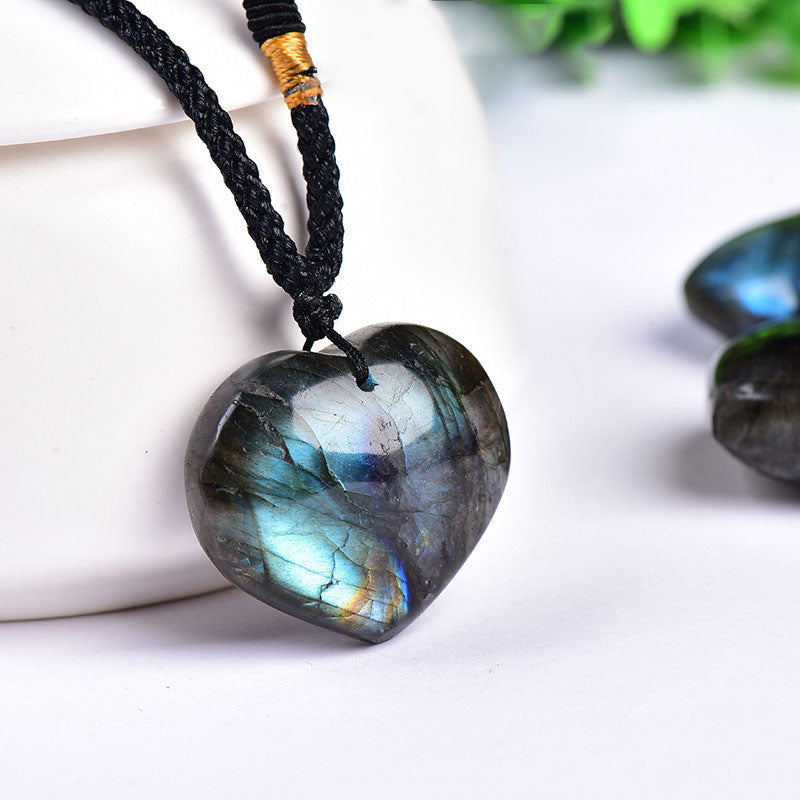
For a pendant or ring, check the angle at which the color appears when the piece hangs or sits on the hand. A beautiful flash that can be seen only from the back or at an awkward tilt may be less satisfying in wear.
Dark backgrounds, wet surfaces, high contrast, and strong spotlights can make colors look more dramatic. A hand-held scale photo helps you judge size, while side views reveal thickness, dome height, chips, and setting depth.
Cut Determines How Easily You See It

The iridescent layers have an orientation. A cutter must find that plane and polish a face that displays it. Cabochons and smooth freeforms are common because a curved surface can make the flash visible over a wider range of angles.
A high dome can create movement and depth, but it should not hide a thin stone or unstable base. Flat carvings and beads can also work well when their broad faces are aligned with the color-producing structure.
Judge the placement as well as the intensity. A centered sweep across the face may suit a simple pendant, while broken patches of blue and gold can give a carving a more varied landscape. Neither pattern is automatically better.
Colour, Bodycolor and Surface Condition
Blue and green are common in commercial labradorite, while yellow, orange, red, violet, and multicolor displays also occur. The label 'spectrolite' is especially associated with dark Finnish material showing a broad spectrum, but it should not be used as a loose synonym for every colorful piece.
Look at the base material between flashes. It may be gray, dark gray, brownish, translucent, or nearly colorless. Cloudy areas, mineral inclusions, fine lines, and colorless patches can be natural, yet open cracks and chips still affect durability.
Inspect edges, points, bead holes, and the back of the stone. Feldspar has cleavage, so a sharp impact can cause a chip or break even when the polished face looks sound.
Labradorite, Moonstone and Rainbow Moonstone
Labradorite and moonstone are both feldspars, but the trade names refer to different material and optical appearances. Labradorite is known for directional, often saturated spectral flashes called labradorescence.
Classic moonstone is associated with a softer, billowing white or blue glow called adularescence. GIA describes 'rainbow moonstone' as transparent labradorite with multicolored sheen, despite the accepted trade name containing moonstone.
These boundaries can confuse buyers. Ask for the stated mineral identity and judge the actual optical effect instead of assuming that any pale iridescent feldspar belongs to one exact category.
Beads, Pendants and Rings
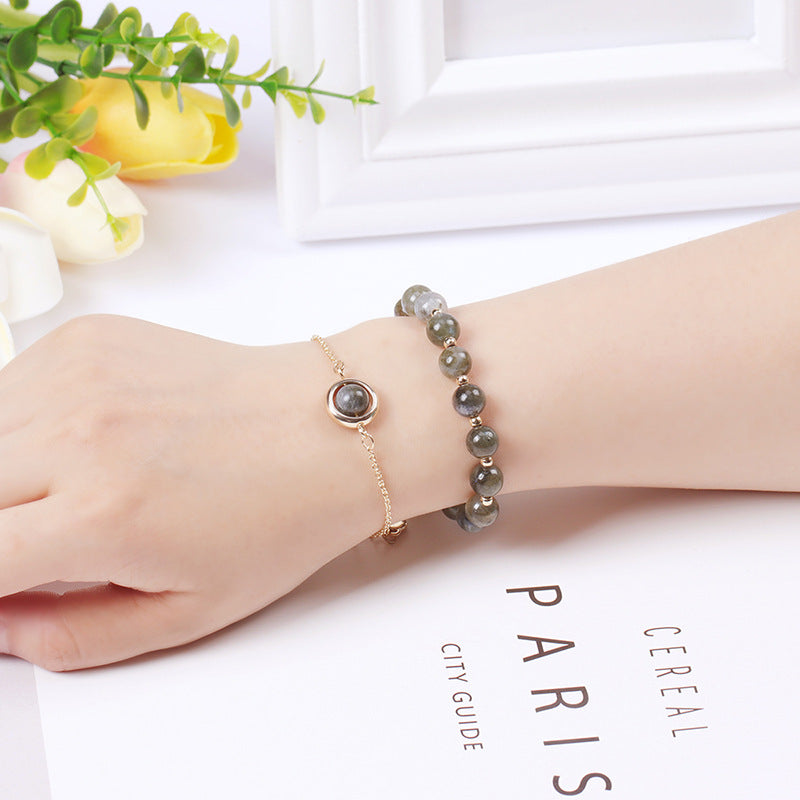
In a bead strand, not every bead will face the light at the same time. Request a full-strand video and decide whether you prefer consistently placed blue flashes or a mix of colors and quieter beads.
Check bead diameter, inner circumference, total weight, drill-hole condition, cord type, and knot security. Rough holes and sharp-edged chips can wear elastic. Roll a stretch bracelet over the hand instead of pulling one section hard.
Pendants and earrings generally face fewer knocks than rings. If you choose a ring, a protective bezel or low setting can help, but it cannot remove feldspar's cleavage or make a heavily fractured stone impact-proof.
Buying Questions That Produce Useful Answers
Ask whether the images show the exact piece, whether the color video has been edited, and what the stone looks like without direct flash. Request dimensions, weight, metal and plating details, construction method, and return terms.
Ask whether the material is natural or synthetic and whether it has been dyed, coated, filled, stabilized, assembled, or repaired. For a claimed Canadian, Finnish, Madagascan, or other origin, request evidence tied to the item or lot.
Descriptions such as AAA, top grade, healer grade, or high vibration are not universal gemological grades. Replace those labels with observable details: flash coverage, viewing angle, transparency, chips, fractures, symmetry, polish, and craftsmanship.
Care for Labradorite Jewelry
Use lukewarm water, a small amount of mild soap, and a soft cloth for many intact untreated pieces. Clean briefly, rinse without soaking a strung or glued item, and dry it before storage.
Avoid steam, ultrasonic cleaning, sudden heat, harsh chemicals, and abrasive compounds. These can threaten fractures, cleavage, fillers, coatings, adhesives, plating, cord, and the polished surface.
Remove labradorite for swimming, bathing, exercise, housework, gardening, and manual work. Store pieces separately so harder gems and metal edges do not scratch them, and inspect prongs, cord, and drill holes periodically.
Cleansing Rituals and Physical Cleaning
Some owners use smoke, sound, moonlight, or a quiet pause as a symbolic cleansing ritual. Such practices are matters of belief and should be kept separate from the physical task of removing skin oils and dirt.

Water is not needed for a spiritual ritual, and long soaking is a poor default for jewelry that may contain glue, cord, plating, fillers, or unknown treatments. Prolonged strong sunlight may also heat a piece and is unnecessary for cleaning.
A simple routine is enough: wipe the surface after wear, use mild soapy water only when the construction allows it, dry carefully, and place the piece in its own soft pouch.
Personal Symbolism, Zodiac and Birthstone Claims
Modern crystal guides associate labradorite with magic, transformation, boundaries, intuition, courage, or several zodiac signs. These pairings vary by author and tradition; they are not material properties measured by gemology.
Labradorite is not on the conventional modern monthly birthstone list used by major gem organizations. 'Pisces stone' and similar phrases describe optional modern associations rather than an official replacement for a month's established birthstones.
If the changing flash represents adaptability to you, let it mark a specific action you control. The jewelry can carry personal meaning without claims that it absorbs other people's moods, removes anxiety, or guarantees clear sight.
Conclusion

View labradorite from more than one angle before buying. The best sales material shows the strongest flash and an ordinary view of the same piece, along with its size, condition, construction, and treatment information.
Choose the color movement and cut you enjoy, then care for the feldspar as a material that can scratch, cleave, and chip under a hard blow. Its visual change is already distinctive; it does not need a medical or emotional promise.
Factual References
Gemological Institute of America, 'Optical Effects of Phenomenal Cabochons': https://www.gia.edu/gia-news-research/optical-effects-phenomenal-cabochons
Gemological Institute of America, 'Structures Behind the Spectacle': https://www.gia.edu/gia-website/gems-gemology/summer-2025-phenomenal-gemstones
Gemological Institute of America, 'Moonstone Description': https://www.gia.edu/gia-website/moonstone-description
Gemological Institute of America, 'Gems Formed in Magmatic Rocks': https://www.gia.edu/gems-gemology/winter-2022-colored-stones-unearthed
Related Reading
Frequently Asked Questions
Why does labradorite flash different colours
Light interacts with fine intergrowth structures inside the feldspar. The color changes with the orientation of the polished face, the light source, and the viewer, producing labradorescence.
Should labradorite flash from every angle
No. Labradorescence is directional, so a stone can look bright from one angle and gray from another. Ask to see both its strongest flash and its ordinary appearance.
Is rainbow moonstone actually labradorite
GIA describes rainbow moonstone as transparent labradorite with multicolored sheen. The trade name is accepted, but it is not classic orthoclase moonstone.
Is labradorite an official birthstone
It is not on the conventional modern monthly birthstone list used by major gem organizations. Zodiac and alternative birthstone pairings vary among modern crystal guides.
How should I clean labradorite jewelry
Use mild soap, lukewarm water, and a soft cloth for many intact untreated pieces. Avoid steam, ultrasonics, hard knocks, harsh chemicals, and long soaking when treatments or construction are uncertain.


